Published by Adrian Vogel · Reading time: approx. 5 minutes · Last updated: November 2026 · Jurisdiction: Germany
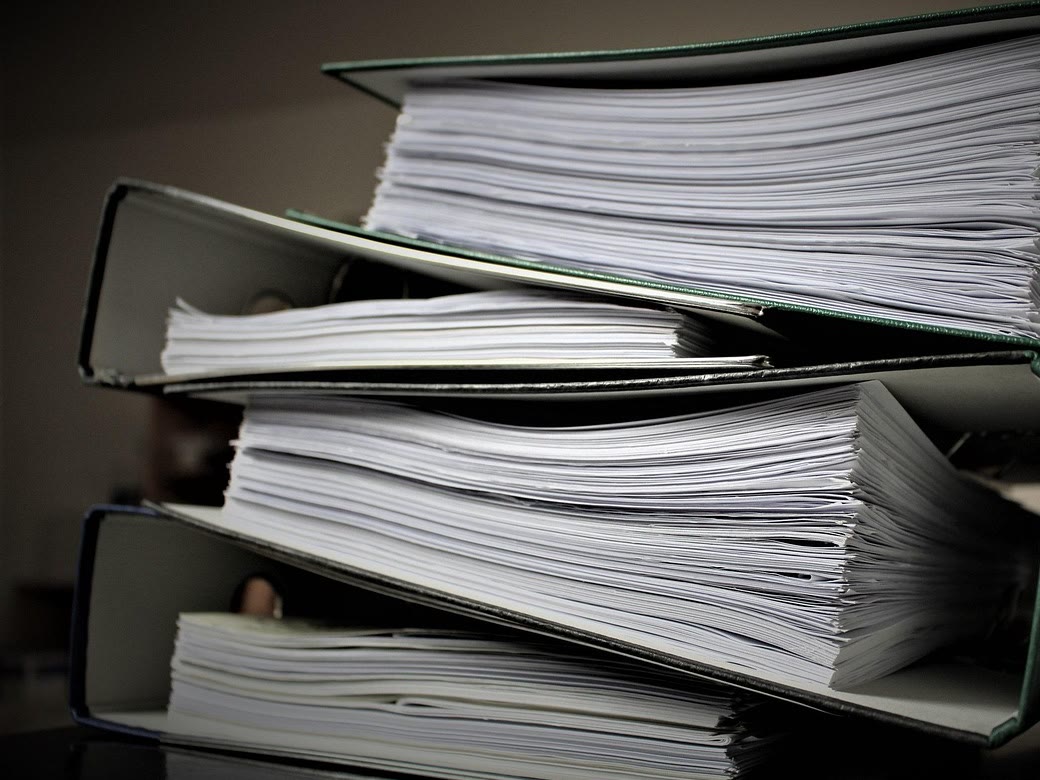
Jana has weighed the files. Four of them, labelled 2011 to 2019, 7.4 kilos together on the kitchen scales. They sit on the hall shelf exactly where the box of winter things is meant to go. Since 2020 her bank has sent statements only as PDFs to the online banking inbox. The files have not grown since, and Jana has not opened one of them.
She still does not dare throw them out. Her mother kept bank statements for ten years, "because of the tax office". Before Jana fetches the shredder from the cellar, she wants to know whether that is true.
Jana is made up; her story is an example.
Before you start: Guidance under German law, not legal advice. Not tax advice either: whether a record counts for your tax return is something to check with your tax office or tax adviser if in doubt. As of November 2026.
The ten years come from business
In Germany, private individuals have no general obligation to keep bank statements. The ten years Jana's mother remembers applied to businesses and the self-employed: for them a bank statement is a bookkeeping record. Since 2025 the period for such records has been eight years (Fourth Bureaucracy Relief Act, § 147(3) of the German Fiscal Code, AO).
There is only one exception for private people. Anyone with more than €500,000 a year in income from employment, capital or letting must keep the related records for six years (§ 147a AO). That does not apply to Jana.
Three years is the usual advice
The consumer advice centre in Lower Saxony recommends keeping receipts and bank statements for at least three years, and the German savings banks say the same. The reason is the limitation period. Most everyday claims become time-barred after three years, and the clock only starts at the end of the year in which they arose (§§ 195, 199 of the German Civil Code, BGB). If a landlord says the rent for March 2023 never arrived, the statement shows the transfer. From 1 January 2027, a claim from 2023 can usually no longer be enforced.
For the four files, that means 2011 to 2019 are long past. And what goes is not lost for good. Banks keep account movements for ten years themselves and can supply old statements again, for a fee. In 2023 the Bavarian tax assistance association Lohnsteuerhilfe Bayern put it at four to 15 euros per replacement statement.
Try it with a statement from your own files: pick the year and tick what is on it.
Try it now
Free for 14 days, no payment details. All you need is your email address.
Registration is subject to our Terms and Conditions and Privacy Notice.
Three payments count for longer than three years
Jana does not want to shred anything unread. One evening she leafs through the files with a pad of sticky notes beside her. Then she scrolls through the PDFs in the inbox. She puts down three notes.
The first is in the 2019 file: €2,380 to the bike shop, the e-bike she still rides to work. The till receipt has vanished. The two years of statutory warranty are long over, but as long as Jana owns the bike, this line is her only proof of when, where and for how much she bought it. Anyone who buys the bike from her second-hand will ask exactly that.
The second is a PDF from 2025. A heating engineer repaired the boiler in the flat she owns, €412 by bank transfer. For work on a house, flat or plot of land, even a private person must keep the invoice, a proof of payment or another conclusive document for two years, counted from the end of the invoice's year (§ 14b of the German VAT Act, UStG). For Jana, that means until the end of 2027. She also claims the labour costs in her tax return. The tax office only accepts them if there is an invoice and the money went into the firm's account (§ 35a of the German Income Tax Act, EStG). Cash does not count.
The third is a donation from December 2025, €50 to the animal welfare society. For donations of up to €300 to a charitable association, the bank statement is enough proof, provided Jana also has the charity's own receipt with its purpose and tax exemption printed on it (§ 50(4) EStDV). She must keep both until a year after the tax assessment (§ 50(8) EStDV). She will do her 2025 return in the spring. If the assessment arrives in June 2026, the statement stays until June 2027.
The three records now sit with their objects
In a file, Jana would be hunting for those three pages again in 2028. So she puts them where they belong: with the thing they are about.
A full statement, though, also shows every other payment that month. So Jana photographs only the one line with date, payee and amount; for a PDF a screenshot does the job. On the e-bike she chooses Upload File under Attachments, then Or choose the type yourself, Purchase & value and Purchase Receipt. Choosing the type yourself costs no AI credit. She enters Purchase Price, Purchase Date and Purchase Location herself, because those fields are how she will find the record later.
On the boiler she uses Add Event to record the repair, with date and amount. The invoice and the transfer hang on it as attachments. The donation belongs to no object. Jana attaches both to her current account, which she has recorded as an object of the type money: the statement under Purchase & value as Account statement, the charity's letter under Media & other as Other document.
The boiler and the current account get the tag Tax 2025. That matters, because OWNAMIC does not search the text of files. The search knows the name, description and tags of objects. With the tag, Jana will find both records in the spring without opening a single file.
That leaves the PDFs in the bank's inbox. How long they stay there is up to each bank. The savings banks say theirs can be retrieved without a time limit; according to Lohnsteuerhilfe Bayern, other banks delete monthly statements from online banking after as little as 90 to 365 days. So once a year Jana downloads the previous year's statements and saves them in a folder on her computer.
The winter box now sits on the hall shelf
On Sunday afternoon the shredder runs for a good hour. Nothing goes into the paper recycling in one piece, because every statement carries her name, her IBAN and what she spent money on. What is left: four empty files and three records with three objects.
The PDFs from 2023 are still in the inbox. Their three years run out in January, and Jana will decide then whether they go.
How to file till receipts and invoices the same way is shown in Finding Receipts: Till Slips and Invoices Step by Step. More on the edition: Home inventory. To try it: 14 days free, no payment details; paid afterwards, cancel any time.
Read on: Contract deadlines at year end · Digital inventory management
Try it now
Free for 14 days, no payment details. All you need is your email address.
Registration is subject to our Terms and Conditions and Privacy Notice.
Sources
- German Civil Code (BGB) § 195, three-year regular limitation period (German): gesetze-im-internet.de
- German Civil Code (BGB) § 199, starts at the end of the year (German): gesetze-im-internet.de
- German Fiscal Code (AO) § 147(3), bookkeeping records eight years (German): gesetze-im-internet.de
- IHK Karlsruhe: Fourth Bureaucracy Relief Act, bookkeeping records from 10 to 8 years (German): ihk.de
- German Fiscal Code (AO) § 147a, six years above €500,000 of income (German): gesetze-im-internet.de
- German VAT Act (UStG) § 14b(1) sentence 5, private persons, work on property, two years (German): gesetze-im-internet.de
- German Income Tax Act (EStG) § 35a(5), invoice and payment into the firm's account (German): gesetze-im-internet.de
- Income Tax Implementing Ordinance (EStDV) § 50(4) and (8), donations up to €300, keep until a year after the assessment (German): gesetze-im-internet.de
- Verbraucherzentrale Niedersachsen: retention periods – can it go? (as of 24 April 2025; German): verbraucherzentrale-niedersachsen.de
- Sparkasse: keeping bank statements (no duty, three years advised, inbox, reordering; German): sparkasse.de
- Abendzeitung München: bank statements gone? What matters with mobile banking (Verbraucherzentrale Bayern, Lohnsteuerhilfe Bayern; 25 October 2023; German): abendzeitung-muenchen.de
Periods and amounts may change. The information reflects the position in November 2026; the fees for replacement statements date from 2023.